


What is mini led tv is one of the most important questions modern TV buyers are asking today. With so many display technologies available—LED, OLED, QLED, and now Mini-LED—it’s easy to feel overwhelmed.
If you’re trying to understand whether Mini-LED TVs are worth buying, how they compare to other technologies, and whether they deliver real-world benefits, you’re in the right place.
In this complete, in-depth guide, we’ll break down what is mini led tv, how it works, why it looks better, where it excels, and whether it’s the right choice for your home in 2026 and beyond.
What Is Mini LED TV and Why Is It Gaining Popularity?
To truly understand what is mini led tv, you need to see it as an evolution of traditional LED TV technology, not a completely new display category like OLED.
Mini-LED TVs still use:
- An LCD (Liquid Crystal Display) panel
- A backlight system behind the panel
However, the major difference lies in the size and number of LEDs used for backlighting.
The Key Innovation
Mini-LED TVs use:
- Thousands of ultra-small LEDs
- Significantly more dimming zones
Compared to traditional LED TVs, which use larger and fewer LEDs, Mini-LED technology dramatically improves how light is controlled behind the screen.
Why This Matters
This upgrade leads to:
- Much deeper blacks
- Brighter highlights
- Better shadow detail
- Reduced halo effects
- More realistic images overall
This is exactly why Mini-LED TVs are becoming a top choice for buyers who want premium picture quality without jumping to OLED pricing.
How Mini LED TV Technology Works
Traditional LED TV Backlighting

In standard LED TVs:
- LEDs are placed behind or along the edges of the screen
- The backlight shines through the LCD panel
- Light is controlled in large zones
Because of this, traditional LED TVs struggle with:
- Poor black levels
- Light bleeding into dark areas
- Limited contrast
Mini LED Backlighting Explained

Mini-LED TVs take this same concept and improve it dramatically.
Instead of using large LEDs, they use:
- Thousands of tiny LEDs
- Hundreds or thousands of independent dimming zones
Each zone can brighten or dim independently, allowing far more precise lighting control.
Real-Life Viewing Example
Imagine watching a movie scene with a dark sky and bright stars:
- On a standard LED TV:
The entire area lights up → stars look blurry and washed out - On a Mini-LED TV:
Only tiny zones light up → stars look crisp and realistic
This level of control is the defining feature behind what is mini led tv technology.
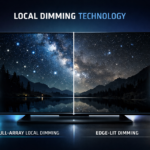
What Is Mini LED TV and Local Dimming Relationship
Local dimming is at the heart of Mini-LED performance.
If you want a deeper breakdown, check this detailed guide on local dimming technology:
What Is Local Dimming?
Local dimming allows a TV to:
- Control brightness in specific screen areas
- Improve contrast
- Enhance dark scene performance
Mini LED vs Traditional Local Dimming
Mini-LED takes local dimming to a whole new level:
- Smaller LEDs = more zones
- More zones = better control
- Better control = better image quality
Why This Is Important
With more zones, Mini-LED TVs can:
- Keep dark areas truly dark
- Keep bright areas bright
- Prevent light from spilling over
What Is Mini LED TV Compared to OLED Technology

One of the most common comparisons when discussing what is mini led tv is OLED.
For a deeper comparison of olded vs qled, you can explore this guide:
OLED TVs Explained
OLED TVs use:
- Self-emitting pixels
- No backlight
- Perfect black levels
Mini LED TVs Explained
Mini-LED TVs:
- Still use a backlight
- But with extreme precision
- Deliver very high brightness
Side-by-Side Comparison
| Feature | Mini-LED | OLED |
|---|---|---|
| Brightness | Extremely High | Moderate |
| Black Levels | Excellent | Perfect |
| Burn-in Risk | None | Possible |
| Price | More Affordable | Premium |
Real-World Usage Differences
- Watching movies in a dark room → OLED wins
- Watching sports in a bright room → Mini-LED wins
What Is Mini LED TV vs QLED Explained

Many buyers get confused between QLED and Mini-LED.
QLED Technology
QLED TVs use:
- Quantum dot layers
- Improved color accuracy
- Higher brightness
But they still rely on standard LED backlighting.
Mini LED Technology
Mini-LED improves the backlight system, not the color layer.
Combined Technologies
Many premium TVs combine both:
QLED + Mini-LED
This gives you:
- Rich colors
- High brightness
- Excellent contrast
Why Mini LED TVs Look Better in Real Life
1. Exceptional Brightness
Mini-LED TVs can get extremely bright.
This makes them ideal for:
- Bright living rooms
- Daytime viewing
- Sports and news
2. Superior Contrast
Because of precise dimming:
- Blacks look deeper
- Whites look brighter
- Images feel more dynamic
3. Reduced Blooming Effect
Blooming happens when light spreads into dark areas.
Mini-LED significantly reduces this issue.
4. Better HDR Performance
HDR content benefits the most.
Mini-LED TVs deliver:
- Brighter highlights
- Deeper shadows
- More vibrant colors
For more technical details about HDR, you can explore Dolby’s official explanation:
https://www.dolby.com/technologies/dolby-vision/
Best Use Cases for Mini LED TVs
Watching Sports
Mini-LED TVs excel at sports:
- Bright stadium lights look natural
- Fast motion remains clear
- Dark areas don’t lose detail
Gaming Performance
Mini-LED TVs are excellent for gaming:
- High brightness enhances HDR games
- Better contrast improves visibility
- Works well with modern consoles
Movies and Streaming
Streaming content looks fantastic on Mini-LED TVs.
For optimizing your viewing experience, check out this guide on the best streaming apps for smart TVs:
Audio Setup Matters
Even the best picture needs good sound.
Consider adding:
- A soundbar
- Surround sound system
Smart TV Performance
A smooth interface enhances your overall experience.
Make sure your TV:
- Runs smoothly
- Supports your favorite apps
Downsides of Mini LED TVs

Despite the benefits, what is mini led tv technology still has limitations.
1. Not Perfect Blacks
Mini-LED comes very close, but OLED still delivers:
- True pixel-level black
2. Minor Blooming in Extreme Cases
Although reduced, blooming can still appear:
- In very high-contrast scenes
3. Premium Pricing at High-End
Top-tier Mini-LED TVs can be expensive.
Mini LED TV Buying Guide
Key Features to Look For
When buying a Mini-LED TV, focus on:
- Number of dimming zones
- HDR support (Dolby Vision, HDR10+)
- HDMI 2.1 ports
- Refresh rate (120Hz for gaming)
Practical Buying Tips
- Choose size based on room
- Consider lighting conditions
- Don’t overpay for features you won’t use
Budget Considerations
Mini-LED TVs are available across price ranges, making them accessible to more buyers.
Future of Mini LED Technology
Mini-LED is expected to evolve rapidly.
Future improvements include:
- Even more dimming zones
- Better efficiency
- Lower prices
It will likely remain a key technology in the premium TV market for years.
Frequently Asked Questions
What is mini led tv and how does it work?
What is mini led tv refers to a television that uses thousands of tiny LEDs in its backlight, allowing precise brightness control and improved contrast.
Is Mini LED better than OLED?
Mini-LED is better for brightness and value, while OLED is better for perfect black levels. Your choice depends on your viewing environment.
Do Mini LED TVs suffer from burn-in?
No, Mini-LED TVs do not suffer from burn-in because they use a backlight system rather than self-emitting pixels.
Are Mini LED TVs good for gaming?
Yes, Mini-LED TVs are excellent for gaming due to high brightness, strong contrast, and support for modern gaming features.
Is Mini LED worth buying in 2026?
Yes, Mini-LED TVs offer one of the best combinations of performance, brightness, and value, making them a great choice in 2026.


Comments are closed.
[…] more here about mini led tv […]
[…] panels, or advanced local dimming, require HDMI 2.1 to perform at their best. If you’ve read about Mini-LEDs, you’ll know how far display technology has […]